
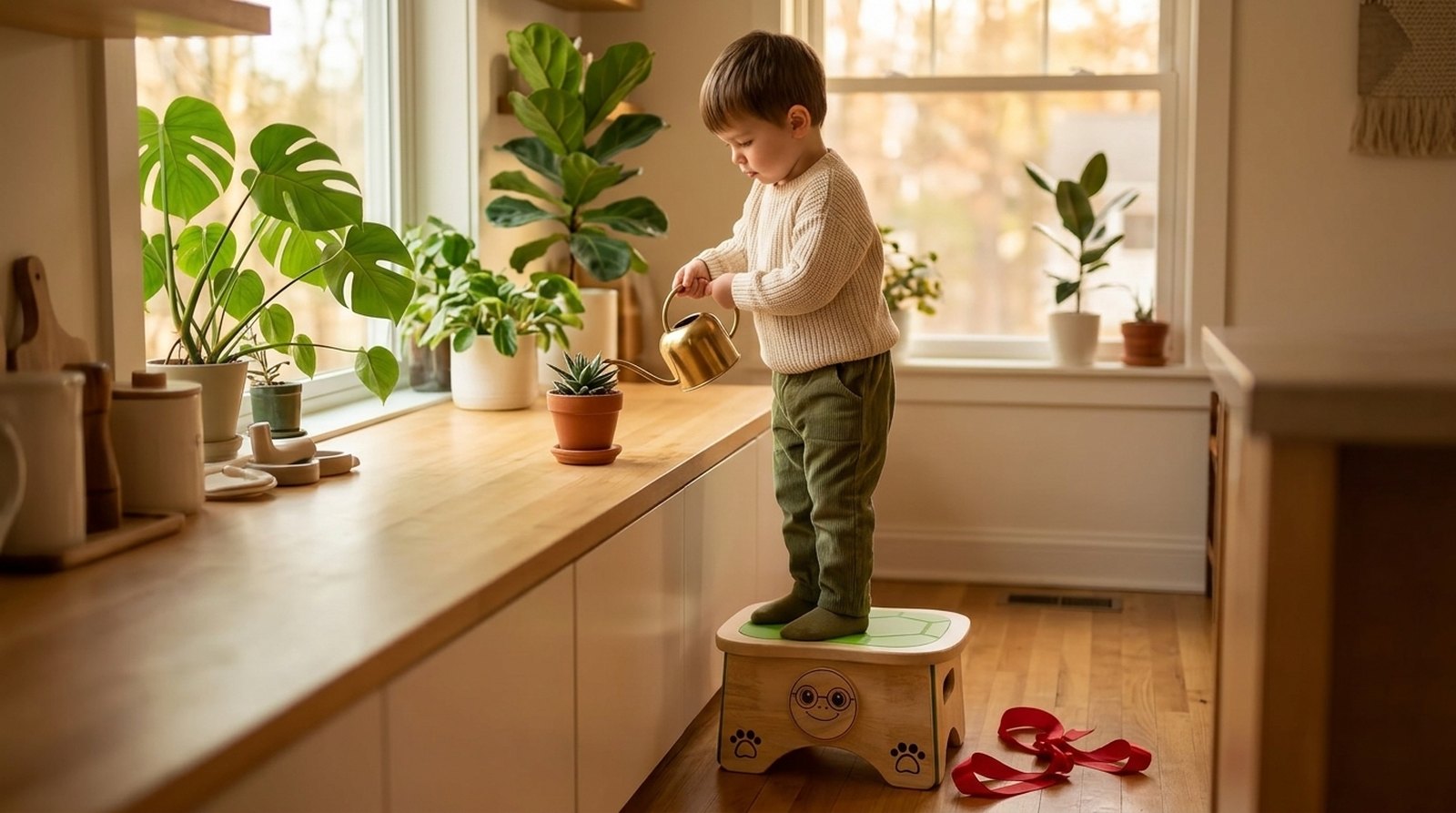
The best Montessori gifts are real things a child uses to do real jobs: pouring their own water, sweeping up a spill, misting a plant, helping at the counter. They get used every day rather than played with for a week. And the one many families say gets used the most is the gift that brings a child up to where family life happens: a step stool. Here is a gift guide built around that idea.
What makes a gift Montessori?
Montessori puts a lot of weight on practical life, the everyday tasks of looking after yourself and your home, done by the child rather than for them. A gift in that spirit tends to share a few things:
- It is real. A real pitcher that pours, a real broom that sweeps. Not a plastic copy that only pretends.
- It fits small hands. Sized for a child, so the job is possible, without being a toy version of the job.
- It does one thing well. Simple, clear, easy to put away.
- It builds independence. After a little practice, the child can use it without an adult doing the hard part.
- It gets used daily. The best gifts become part of the routine, not part of the toy pile.
Montessori gift ideas that build independence
- A step stool. The gift that makes most of the others on this list work. More on why below.
- A child-size apron. For baking, washing vegetables and painting. Putting it on becomes the signal that a job is starting.
- A small real pitcher. Light enough to lift when full, with a spout that pours cleanly. Pouring their own water is one of the most loved jobs in a Montessori home.
- Their own cup. A small glass or sturdy cup that is clearly theirs, used at the table and at the sink.
- A plant mister and a plant of their own. A real living thing to care for, with a job that takes a minute a day.
- A small watering can. For the garden, the balcony or the houseplants on the windowsill.
- A small broom and dustpan. So a spill becomes something they can fix themselves.
- Child-safe kitchen tools without blades. A whisk, a wooden spoon, a small rolling pin, a citrus juicer, a salad spinner. Enough to genuinely help with cooking.
- A set of small cleaning cloths. For wiping the table after a meal or the counter after baking.
- Gardening gloves in their size. For pulling weeds and carrying pots outdoors.
Why a step stool is the gift they use every day
Look at that list again and notice where most of the jobs happen. The pitcher is filled at the sink. The baking happens at the counter. The plant lives on the windowsill. The handwashing, the toothbrushing and the toilet are all at adult height. Almost every practical life gift assumes the child can reach.
A step stool is what closes that gap. It brings your child up to the real kitchen counter, the bathroom sink, the toilet and the window, instead of a smaller version of those places. In a single day it can carry them through brushing teeth, washing hands before every meal, helping with dinner and brushing again before bed. Few gifts get that much use, and fewer still keep getting used once the novelty wears off. We wrote more about this in The Height Where the Day Happens.
What to look for in a wooden step stool as a gift
- Solid natural wood and a wide base, so it stays put when a child leans over the counter or the sink.
- A top that keeps small bare feet from slipping, including wet ones in the bathroom.
- Rounded edges and a carry cutout, so your child can move it from room to room.
- Safety testing to ASTM F2613, the US safety standard for children's chairs and stools, alongside CPSIA compliance.
- Something they recognize as theirs. A character or a look they love makes it a friend, not furniture.
- Something you are happy to leave out. A step stool that looks good in the kitchen stays in the kitchen, where it gets used.
Plastic and wood both have a place. Plastic stools are light, inexpensive and easy to wipe down. Wood is heavier, which helps it stay put, and it tends to look like furniture rather than equipment, which matters for something that lives out in the open.
How to give a step stool so it gets used
A step stool wrapped in paper is a box. A step stool with a job is a gift. A few ways to give it a job from the first day:
- The little baker. A step stool, a child-size apron and a whisk, set up at the kitchen counter with a simple recipe to make together.
- The sink routine. A step stool, their own cup and a new toothbrush, waiting in front of the bathroom sink.
- The window gardener. A step stool, a plant mister and a small plant, by the brightest window in the house.
Then show them what it is for. The first time they step up and reach the counter on their own is usually the moment the gift lands.
Questions parents ask
Is a premium wooden step stool a good gift?
For a child who can step up and down confidently by themselves, yes. It is used several times a day, in several rooms, for as long as they need help reaching, and solid natural wood holds up to that kind of daily use. A character design makes it feel like a present rather than a piece of equipment.
What is a good Montessori gift that isn't a toy?
Something real that helps a child do a daily job on their own: a small pitcher, a child-size apron, a plant mister, a small broom, child-safe kitchen tools without blades, or a step stool that gets them up to the counter and the sink.
When is a child ready for a step stool?
When they can step up and down confidently by themselves and are steady on their feet. Until then, stay close and lend a hand.
Where Stobbi fits
Stobbi makes step stools that are meant to be given, and then used every day. Each one is solid natural wood with a character on top: Doe the Turtle, Ray the Panda and Mei the Butterfly. Pick the one your child will want to say good morning to in the shop. We wrote about why in This Is Not a Stool.