
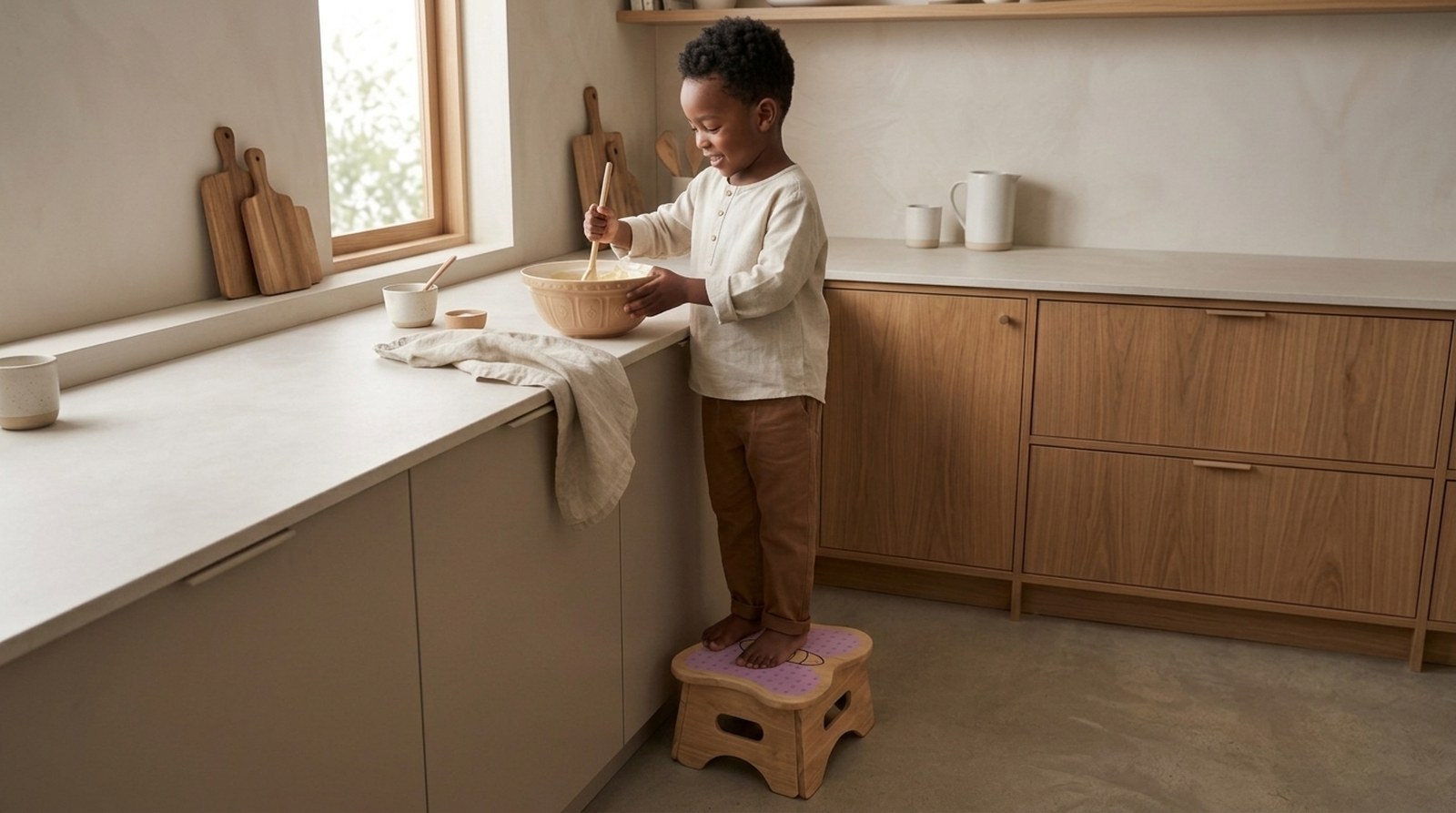
Stand in your kitchen and look at it from three feet up. The counter is a ceiling. The sink is somewhere above that. Everything interesting is happening on a plane your child can hear but not see, which is why so many of them end up attached to your leg at exactly the moment you are draining something hot.
Then do the same thing in the bathroom. The basin, the mirror, the towel hook, the toilet. Same problem, different room, and it repeats several times a day from the moment they wake up.
It would be easy to treat a step stool as a small piece of furniture that closes a height gap. We think it does something larger than that. It decides whether a child spends the busiest parts of the day watching or taking part.
A child who cannot reach the counter is not being difficult. They are being short.
Access comes before willingness
There is a lot of advice about getting children to help at home, and most of it is about motivation. Make it fun, offer a chart, praise the effort. We would put something earlier in the chain than any of that. Before a child can want to help, they have to be able to reach the place where helping happens.
It sounds obvious written down. It is easy to miss in practice, because adults stop noticing counter height the year we grow past it. A job that is trivial for you, rinsing a handful of blueberries, is simply unavailable to someone whose eyeline stops at the cupboard door. Remove the height problem and a surprising amount of the motivation problem goes with it, because doing the real thing alongside you was always more appealing than a pretend version of it on the floor. Children can tell the difference between a job that mattered and a job invented to keep them busy, and they lose interest in the second one quickly.
It was never one room
A stool is for reach, wherever reach is the thing in the way: the toilet, the bathroom sink, the kitchen sink, the counter, and the shelf, hook or windowsill that happens to matter in your house. None of those is the real use with the rest as a bonus.
What the kitchen and the bathroom share is repetition. Meals, handwashing and teeth come round several times a day, every day, and each is full of small tasks that genuinely need doing. Repetition is the active ingredient, not the room. A skill practised once is a novelty. A skill practised at breakfast and again at dinner becomes something your child simply knows how to do.
What a child can actually do up there
More than we expected, once we watched it properly. A rough order, easiest first:
- At a sink, either one. Washing hands, brushing teeth, rinsing berries in a colander, filling their own cup, washing a plastic bowl with far too much water.
- At the counter. Tearing lettuce, stirring batter, pressing cookie cutters, peeling a banana or a hard boiled egg, mashing something soft with the back of a fork.
- Putting away. Wiping the counter with a damp cloth, sorting spoons from forks, carrying their own cup to the sink and their own plate to the counter edge.
- Reaching their own things. A coat on a hook, a book on a high shelf, the light switch. Small, and the ones children seem proudest of.
Our suggestion, having tried the alternative: pick one job and stay with it for a week before adding a second. A short list repeated is worth more than a long list attempted once. The goal is not a child who can do nine things. It is a child who walks in, goes to their Stobbi without being asked, and starts the one thing that is now theirs.
Teaching the climb
The climb is its own skill and it is worth teaching deliberately rather than assuming.
- Show it slowly first, naming each move out loud. Hands on, one foot up, other foot up. Children copy sequences more readily than instructions.
- Stay within arm's reach for the first few weeks. Let them do the work. Keep your hand close rather than on them.
- Give the stool one home. The same spot, every day. A predictable place is what lets a child go to it on their own, which is the entire point.
- Clear the counter edge before they climb. Knives, hot pans and cables move back. This is the one step we would not treat as optional.
- Teach the step down too. It is the harder half and it is the half that gets skipped. Give it the same slow practice you gave the climb up, and stay close while they learn it.
Supervise throughout, especially near water, heat and anything sharp. A stool makes a child capable of reaching the counter. It does not make the counter safe on its own.
A note on the Montessori version of this
People often ask whether a particular stool counts as a Montessori stool. In our reading, the Montessori part was never the object. It is the decision to arrange a home so that a child can reach real tools and do real work without asking to be lifted. A stool is one move in that arrangement. Pairing it with child sized tools, a low shelf they can reach, and a bit of patience for how slow the first month is, matters more than what the stool is called.
What we thought about when we made ours
Being straightforward about the object itself: solid natural wood, a wide base, a low centre of gravity, and CPSIA compliant.
The base is the part we would ask about first if we were buying rather than making. Width and a low centre of gravity are what stop a stool skating or tipping when a child leans out over it to see into a bowl, and leaning out to see into the bowl is the whole activity. Beyond that, measure against your own room before you buy anything, from us or anyone else. Counters and basins vary more than people expect, and the question to answer is whether your child can work with their hands comfortably on the surface rather than reaching up to it.
The part that is not about reaching
One more thing, because it is the reason our stools have faces. Solving the height gets your child to the counter. It does not make them want to be there tomorrow, and it does not make the thing worth having in the room. Those are different problems, and we think they are solved with a story and with care in the making rather than with a specification. That is what the characters are for, and we have written about it separately.
The reach is only the first of those problems. It is just the one that has to be solved before any of the others get a chance.