
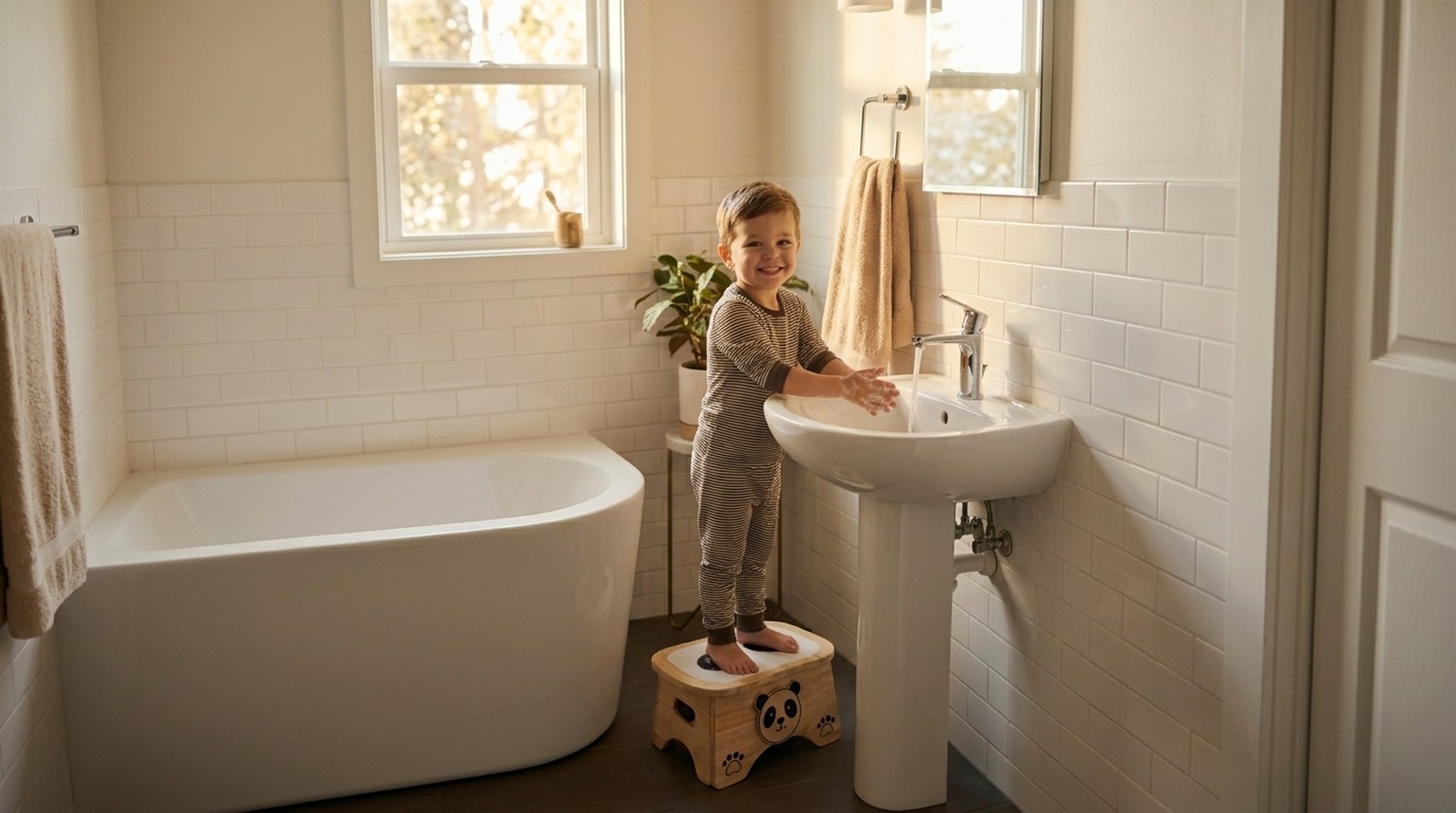
The line on our box reads Every step sparks a story, under the logo. The line we use between ourselves is blunter, and it is the one in the title: this is not a stool. It is an awkward thing for a company that makes them to say, so it is worth explaining what we mean by it.
A step stool solves a measurable problem. Your child is too short for the sink, the thing is some inches tall, the gap closes. That part is engineering and it is not very hard. What it does not touch is the harder problem underneath, which every parent already knows about: the trouble with toothbrushing was never the height of the basin.
The gap a stool does not close
Bathrooms are designed for adults, so a young child's evening runs on being carried, lifted and reminded. Fix the height and you have changed the logistics. You have not yet changed how the routine feels. It is still a thing being done to them at the end of a long day, and they will still negotiate about it, because the only thing that has changed is who is holding them up.
We were not trying to help a child reach the sink. We were trying to give them a reason to go.
So we stopped thinking of it as furniture. The question we ended up asking was not how tall the step should be. It was who is waiting in the bathroom when your child gets there, and whether the thing they find there is worth finding.
Which is roughly the point at which it stopped being a stool to us, and started being a Stobbi.
What a name changes
Give an object a name and a face and children treat it differently. They greet it. They notice when it is in the wrong room. They explain things to it. None of this is a trick, and it is not something we invented. It is the ordinary way young children relate to the world, and most of the objects in a home simply waste it.
What it does to a routine is quite specific. A child who is told to go and wash their hands is receiving an instruction. A child who goes to find their friend at the sink is doing something of their own, and the handwashing comes along with it. Same basin, same twenty seconds, completely different thing happening.
The useful part for parents is that it moves the routine out of the negotiation. You are no longer the person asking. You can be the person who wonders aloud whether anyone has said good morning to Ray yet.
The friendship goes both ways
This is the part we care most about getting right, and it is the part that is easiest to get wrong. It would be simple to build a character who exists to help your child: a cheerful assistant whose job is to make them brush their teeth. We did not want that. A helper your child does not help back is just an instruction with a face on it.
So the characters need things too. Doe gets tired and wants to be somewhere quiet. Ray wants company in the morning. Mei wants to be shown things. Children are unusually good at this. Give them someone to look after and they will look after them, and the looking after is where the confidence actually comes from. It is a different feeling from being helped. It is the feeling of being the capable one.
Beauty is not the finishing touch
A name and a face would still only be a decoration on a commodity, and that is not what this is. The harder claim we want to make is that the thing itself should be beautiful, and that beauty is not a luxury you add once the useful parts are paid for.
Look at what is actually sold for small children. Most of it is utilitarian at best: moulded plastic in primary colours, designed to be cheap, stackable and forgettable, on the quiet assumption that a child will not notice and will not care. We think that assumption is both wrong and expensive.
A child who is never given anything beautiful does not grow into an adult who can make anything beautiful.
Taste is not issued at eighteen. It is built, early and slowly, out of what was within reach when nobody was paying attention: the weight of a real wooden thing, a curve that was drawn rather than extruded, a colour someone chose. Give a child years of objects made with no care and you are teaching them, every day and below the level of argument, that care is not something things have. They will grow up able to tolerate the forgettable, which is most of how the forgettable keeps getting made.
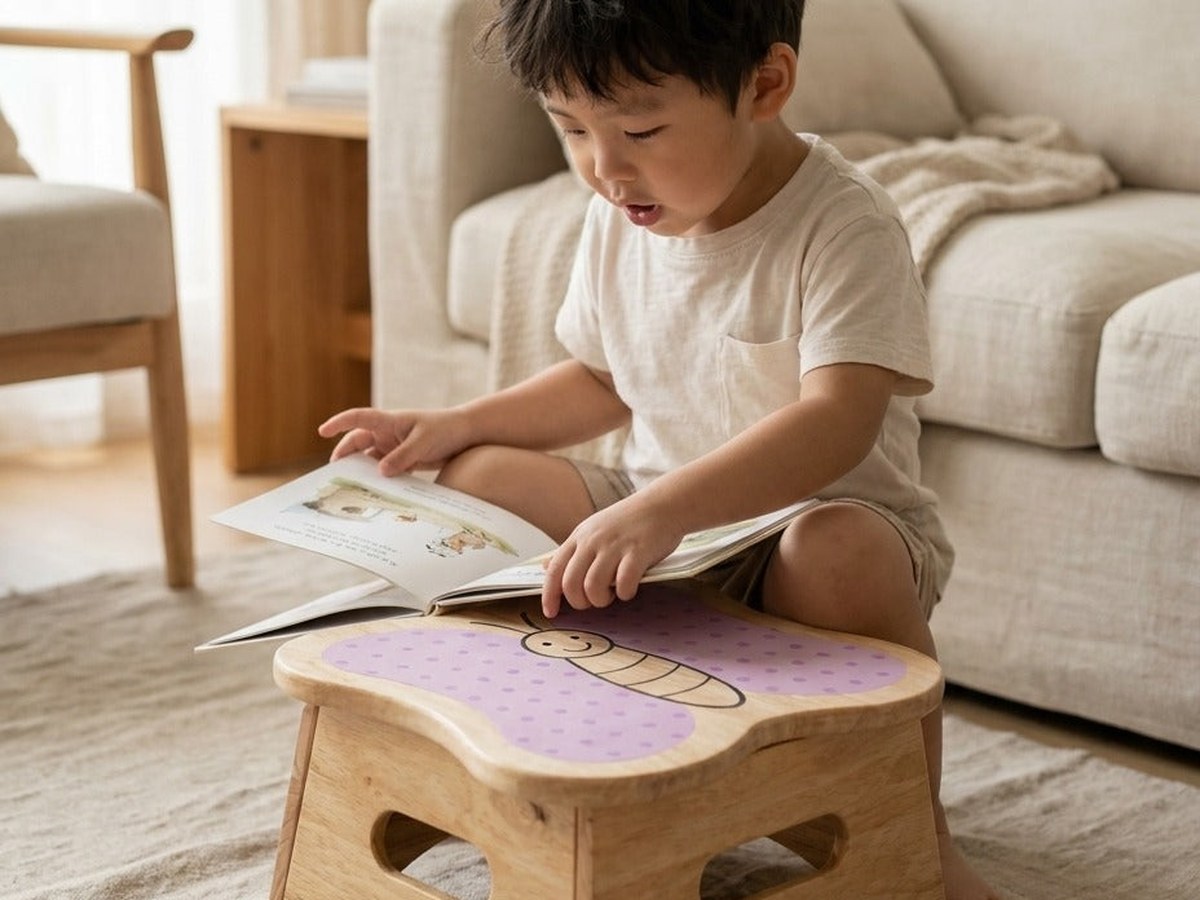
So the shape of the step was drawn, not defaulted to. The characters were illustrated rather than clip-arted. It is solid natural wood because wood has weight and warmth and ages in a way that tells a child the thing was real. None of that makes it work better as a step. All of it is the point.
Doe, Ray and Mei
There are three of them, and they are deliberately not interchangeable.
- Doe the Turtle is the steady one. Carries her home with her, takes her time, and is good company for the child who would rather watch for a while before joining in.
- Ray the Panda is the morning one. Cheerful, a bit much before breakfast, and very hard to be grumpy at while you are washing your hands.
- Mei the Butterfly is the brave one, in lilac. For first times, new rooms and the things that need a bit of courage.
Children pick without much hesitation, usually faster than their parents do, and the one they pick tends to tell you something. After that it is rarely "the stool" in the house any more. It is Ray, or it is their Stobbi.
Playing at the sink
A few things that work, if you want to use the character rather than just own it:
- Ask what the character would do next. It gets your child to recall the sequence of their own routine instead of being walked through it. They are far more willing to remember on someone else's behalf.
- Let them report the day. Brushing goes on much longer when there is a story being told into the mirror.
- Count the wash out loud. Twenty seconds is a long time to a child and a much shorter one when somebody is counting along with them. Numbers slide into a routine without anyone deciding to teach them.
- Check in on the character. Does Ray need anything this morning? This is the reciprocal half, and it is the one that tends to get skipped.
- Say goodbye at the end. A small ending makes the whole thing feel finished, which is mostly what stops the drifting away mid routine.
Setting the room up around it
The Stobbi gets your child to the basin. What is worth doing next is making sure everything they need once they are up there is inside the same reach: the towel, the cup, their own toothbrush. Those tend to be hung and stacked at adult eye level out of habit rather than for any good reason. Keep it in one consistent spot too, so it can be found without asking. Practise the climb up and the climb down slowly, giving the step down the same attention as the climb, and stay close while the habit forms. Then allow it to be slow. The extra four minutes in the evening is not the cost of the thing. It is the thing.
Being plain about the object
None of the above excuses a Stobbi from being well made. Ours are solid natural wood, with a wide base and a low centre of gravity, CPSIA compliant and made for ages 3 and up. Measure against your own basin before buying anything, ours included, and supervise your child while they climb. The character is the reason they will want to. The making is the reason you can let them.