
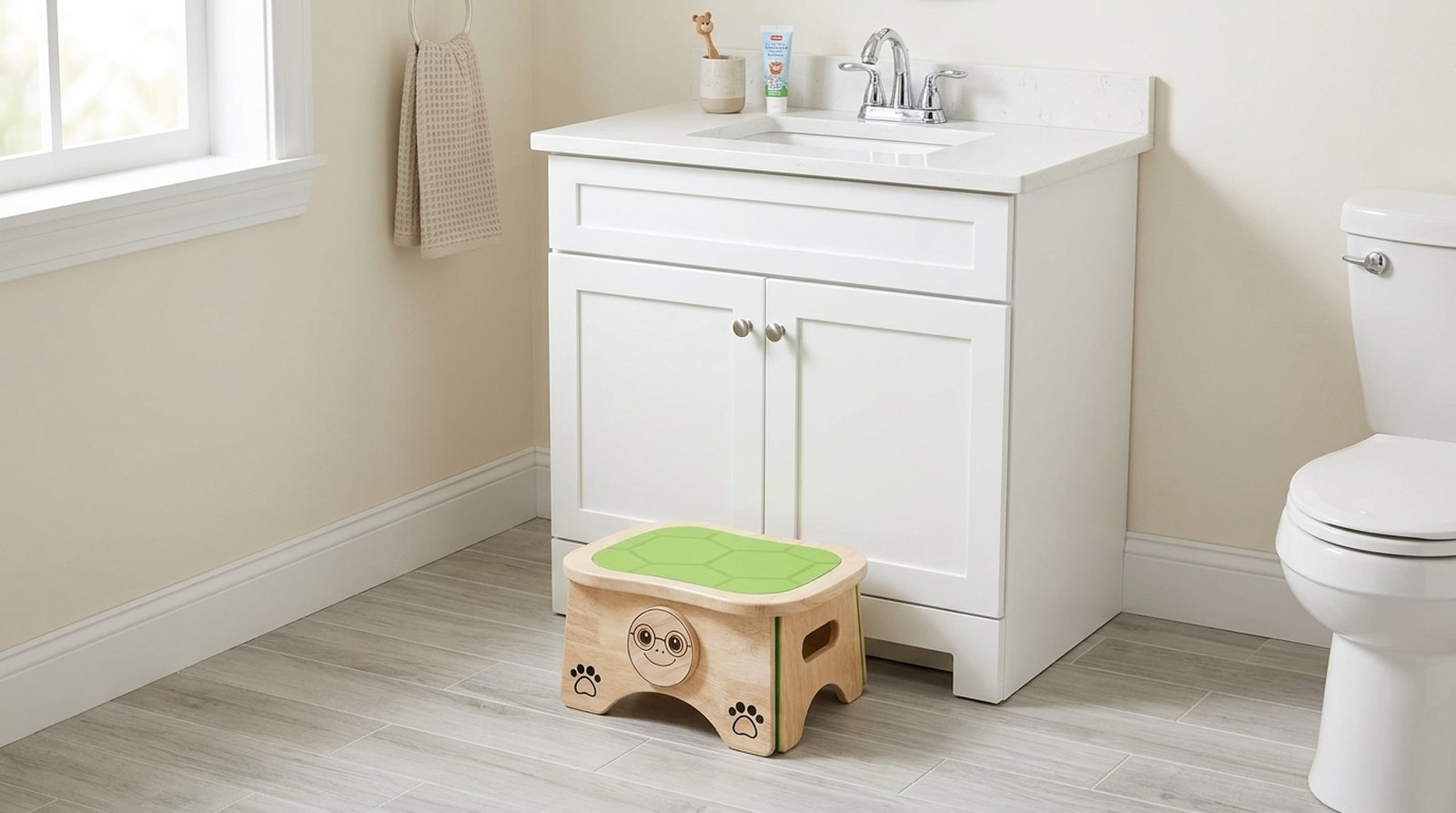
A step stool only helps when it is where your child needs it. That sounds obvious, but it is where most step stools fail. They get folded, slid behind a door or tucked under the vanity after each use, and a step stool that has to be fetched first is one that often does not get fetched at all. The step stools that get used are the ones that stay out. This post is about why a step stool with a face is easier to leave out, and why that matters more than any single feature on the spec sheet.
The step stool that gets put away
Most step stools for kids are designed as equipment. Plastic in a bright color, a shape chosen to be cheap to mold and easy to stack. There is nothing wrong with that, and plenty of families get good use from one. But equipment has a habit of being tidied away. It looks like clutter in a bathroom you have just cleaned, and it looks out of place next to the kitchen counter when guests come over.
So it goes behind the door. And the next morning, at the sink, the toilet or the counter, someone has to go and get it, set it down, and put it back afterward. Each of those moments is a small reason for an adult to just lift the child instead. That is the quiet way a useful step stool turns into one that sits in a cupboard.
A face makes it something you leave out
A step stool designed as a character changes the question. It is no longer a piece of equipment you are storing in plain sight. It is Doe, or Ray, or Mei, and Doe lives by the bathroom sink. Families tend to find it easier to leave a character in the room than a gadget, because it reads as part of the room rather than something waiting to be put away.
This is the reason each Stobbi step stool is solid natural wood with a character on top, rather than a plain stool with a sticker. The aim was something that looks right staying out all day, in a bathroom, beside the toilet or at the kitchen counter, so it is already there when your child needs to reach.
A name makes it easy to talk about
A character also gives the step stool a name, and names are useful in a busy house. "Go and get the stool" is an instruction. "Is Ray by the sink?" is a question your child can answer, and it tells both of you exactly where the step stool should be. When the step stool has a usual spot and a name, finding it, using it and bringing it back all get simpler.
It works at the toilet too. A step stool that lives beside the toilet, rather than one that gets carried in when someone remembers, means your child can get on, keep their feet supported and get down again whenever they need to go, not only when an adult is free to help.
The friendship goes both ways
We think about Doe, Ray and Mei as friends, and we are careful about what kind of friend. A character that exists only to get your child to brush their teeth is a reminder with a face. A friend is someone you help and who helps you back. Doe, Ray and Mei give your child a lift up to the sink and the counter, and your child can look after them in return: say good morning, decide where they live, dust them off, carry them to the next room. Both halves are part of the idea.
How to help a step stool stay out
- Give it a home. Pick one spot where it lives, usually the bathroom, where the sink and the toilet are used many times a day.
- Leave a clear path. Keep the floor in front of the sink or toilet clear so the step stool can sit there without being in the way.
- Let your child carry it. A carry cutout and a sensible weight mean a child who can step up and down confidently by themselves can move it to the next room and back.
- Use its name. Ask where it is, rather than telling your child to go and fetch it.
- Consider two. Many families keep one step stool in the bathroom and one in the kitchen, so neither routine has to wait.
What to check besides the face
A character is a reason to leave a step stool out. It is not a reason to skip the basics. Look for a wide base, a top that keeps small bare feet from slipping, rounded edges, a carry cutout, and testing to ASTM F2613, the US safety standard for children's chairs and stools, alongside CPSIA compliance. Stay close while your child gets used to it, and keep it clear of the stove and anything hot or sharp.
Questions parents ask
Is a character step stool just for looks?
The character is there so the step stool is easy to leave out and easy to talk about. It sits on the same things that matter in any step stool: a wide base, a top that keeps small bare feet from slipping, rounded edges and a carry cutout.
What age is a Stobbi step stool for?
Ages 3 and up, for children who can step up and down confidently by themselves.
Where should the step stool live?
Wherever your child needs to reach most often. For many families that is the bathroom, between the sink and the toilet.
Where Stobbi fits
Stobbi makes step stools in solid natural wood, on a wide base with a top that keeps small bare feet from slipping, rounded edges and a carry cutout. Every Stobbi step stool is CPSIA and ASTM F2613-22 compliant, and each one is designed as a character: Doe the Turtle, Ray the Panda and Mei the Butterfly. Each has a name and a face, so the step stool your child reaches for at the sink or the toilet is a friend they know, one they help and who helps them back. See all three in the shop, and read more about the idea in This Is Not a Stool.