
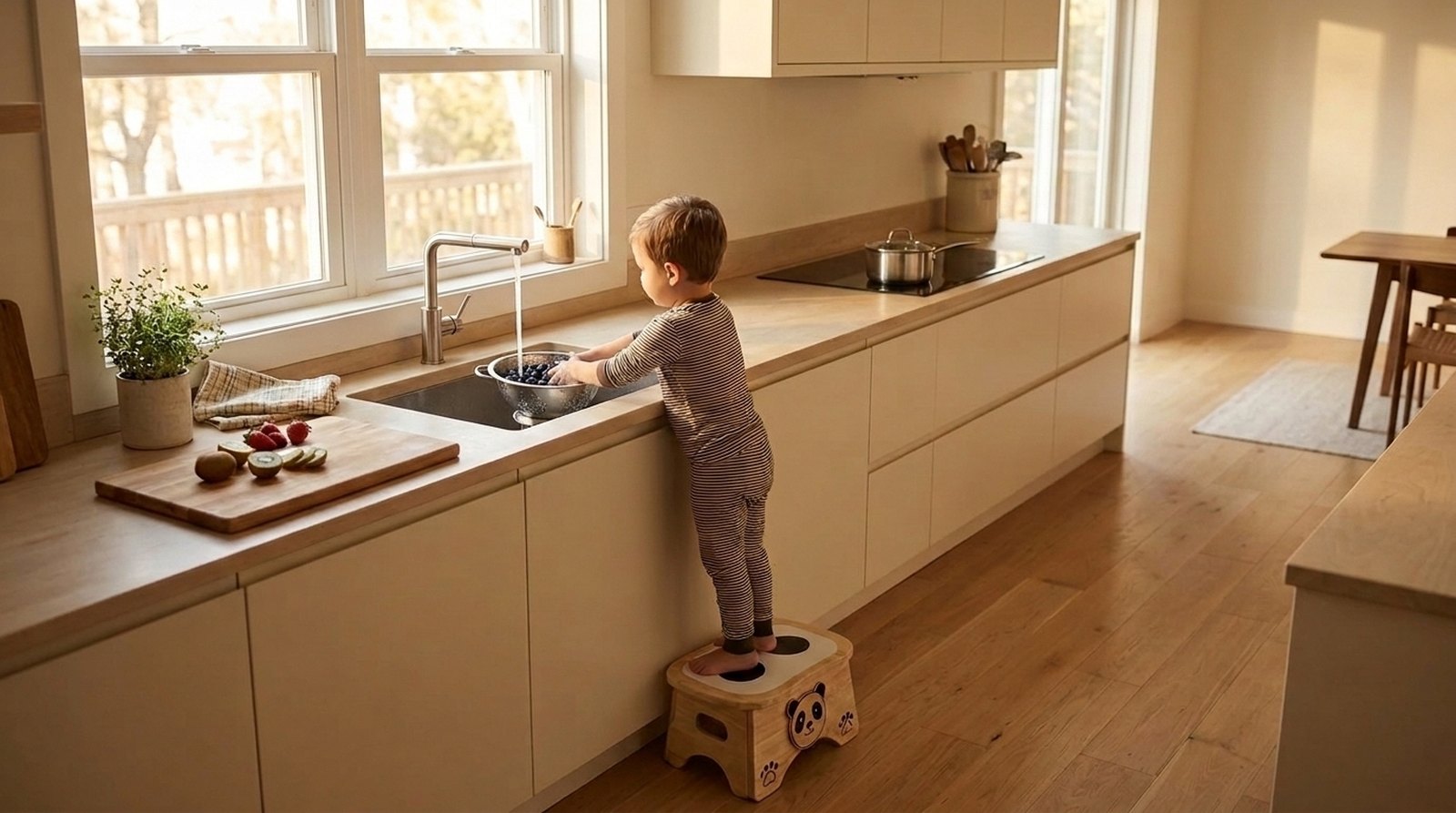
If you have started looking for a way to get a small child up to the counter, you have probably met two kinds of answer. One is the toddler tower, also sold as a learning tower or kitchen helper: a tall platform with rails around it. The other is the step stool. They are often shown side by side as if one were the cheaper version of the other. They are not. They solve different problems, and the useful question is which problem you have.
We make step stools, so read this knowing which side of the counter we stand on. We have tried to be fair about where a tower is the better choice, because for some families it is.
What a tower is for
A tower lifts a child to counter height and surrounds them while they are up there. The rails mean a child who is still unsteady, or who has not yet learned to stay put, can stand at the counter through a whole stretch of cooking without you holding on. Many have an adjustable platform, so the same tower can follow a child through several years.
That is a real advantage for one specific job: a younger child taking part at the kitchen counter for longer periods. If that is the picture in your head, a tower is probably what you want.
The trade is size. A tower has a large footprint, it is heavy enough that it tends to stay where it is put, and it is built around one surface. Most live permanently at the kitchen counter. Some fold, and the folding ones still take an adult to move.
What a step stool is for
A step stool adds a few inches wherever a few inches are the problem: the bathroom basin, the toilet, a light switch, a coat hook, a shelf, and the kitchen counter too. It is small enough to move between rooms, open on every side so a child can get on and off without help, and easy to keep out of the way.
The open sides are the point and the limit at once. A stool asks more of the child. They have to climb on, stand steadily and step down by themselves. That is why ours are designed for children who can step up and down confidently by themselves, and why we would not suggest a stool for a child who still needs to be held in place.
The questions that decide it
- How steady is your child? A child who is not yet confident stepping up and down by themselves, or not yet steady on their feet, points to a tower. A child who steps up and down confidently and is steady on their feet is ready for a stool.
- Which room is the problem? If it is mostly the kitchen counter, a tower does that one job very well. If it is the basin in the morning, the counter at dinner and the hook by the door, a stool goes where the problem is.
- How much floor do you have? Measure the space in front of your counter and your basin. A tower needs somewhere to stand permanently. A stool only needs somewhere to wait between uses.
- How tall is the surface, really? Stand your child next to it. A tower brings them up to the counter. A stool adds a step, which at a bathroom basin or a lower counter is often all that is missing, and at a high counter may not be enough for real work.
- Where will it live? A tower stays put, which is reassuring in a kitchen and awkward anywhere else. A stool can have one predictable home in the room your child uses most, which is what lets them go to it without being asked.
Some families have both
It does not have to be one or the other. Some families keep a tower at the kitchen counter through the toddler years and a stool in the bathroom, where a tower would not fit and is not needed. As the child grows steadier, the stool tends to take over more of the house. We wrote about why reach matters in every room, not just the kitchen, in The Height Where the Day Happens.
What to check on any step stool
Whoever you buy from, a few things are worth checking. A wide base and a low center of gravity, so the stool does not tip when a child leans forward over a bowl or a basin, which is exactly what they will do. A top that does not slip under small feet. Rounded edges. And testing to ASTM F2613, the US safety standard for children's chairs and stools, alongside CPSIA compliance.
Whichever you choose, stay close, especially near water, heat and anything sharp.
The short version
A tower is the better tool for a younger child working at one counter. A step stool is the better tool for a child who is steady on her feet and needs to reach many things in many rooms. Work out which of those describes your house, and the choice mostly makes itself.