
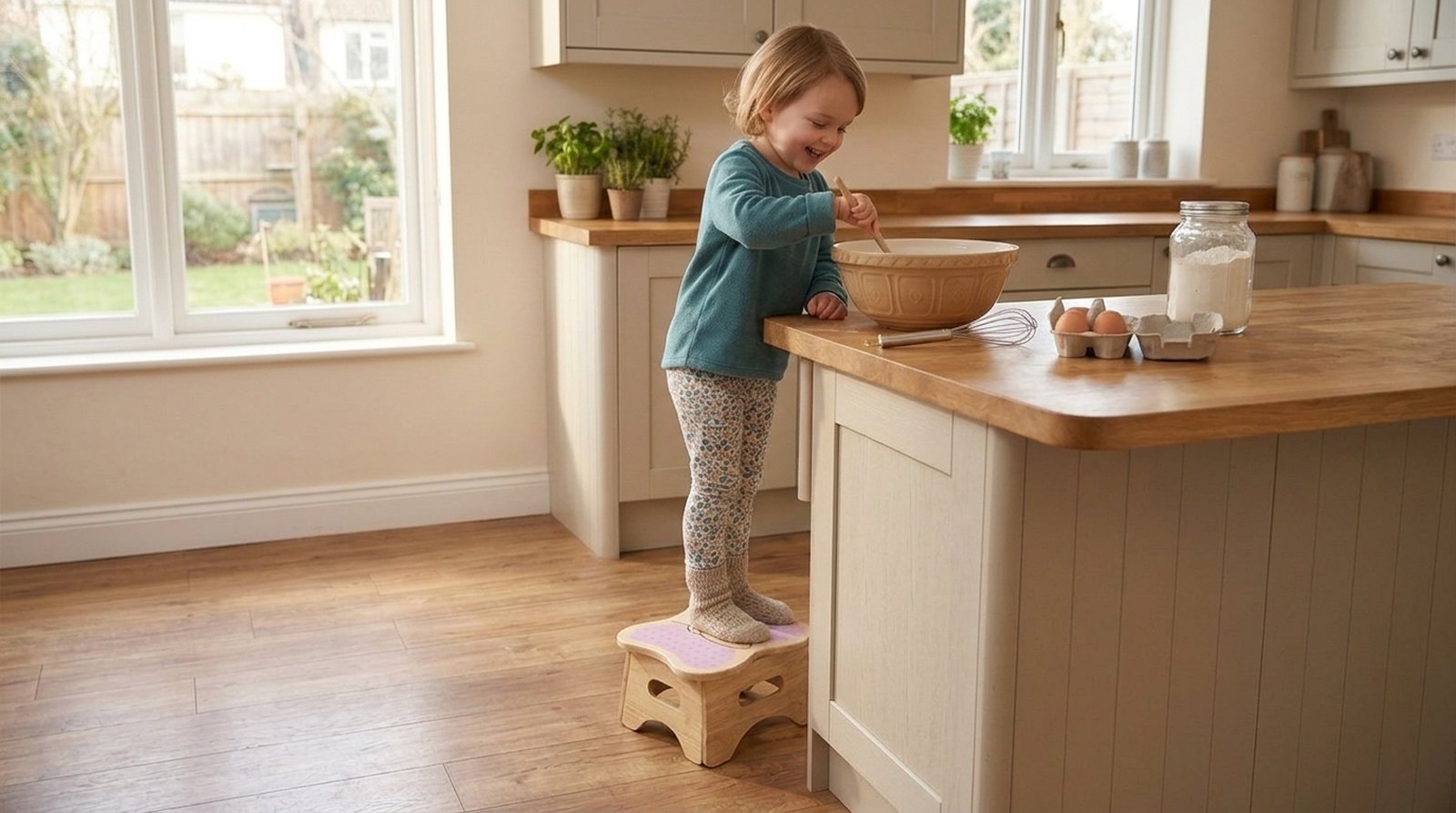
The height of step stool your child needs is the height that closes the gap between where they can comfortably reach and where the job is: the bathroom sink, the kitchen counter, the toilet. For most daily routines, a small step stool with one level does that. A two-step stool or a toddler tower only earns its extra height when the gap is too big for one. The quickest way to know which side of that line you are on is to measure, and it takes about a minute.
How do I work out the height my child needs?
Do it at the place your child will use the stool most, usually the bathroom sink.
- Stand your child next to it, the way they will use it.
- Notice where the edge meets them. If the counter is at their chin or shoulders, their hands cannot work over the basin and they cannot see into it.
- Picture where it should meet them. Around the waist is comfortable: forearms clear the edge, hands reach the water, and they can see what they are doing without stretching.
- Measure the difference. With a tape measure, check the height from the floor to the counter edge, then from the floor to your child's waist. The gap between the two is roughly the lift a step stool needs to give.
- Check the tap. From that height, can your child reach the tap and turn it on and off without climbing onto the counter? If yes, the height is right.
Repeat it at the kitchen counter and the toilet if you want one stool to work everywhere. In many US homes the bathroom vanity is a little lower than the kitchen counter, so a stool that is just right at the sink may leave your child a little lower at the counter, which is often fine for watching, rinsing and stirring.
Why one level suits most daily routines
Handwashing, toothbrushing and the toilet happen several times a day, often in a hurry. A single-level step stool fits that rhythm.
- Quick on, quick off. One movement up and one movement down. Children master it fast, so the routine is theirs sooner.
- Low and steady. A lower platform keeps your child's weight close to the floor, and a wide base on a small footprint stays put when they lean over the basin.
- Easy to move. A small step stool with a carry cutout goes from the sink to the toilet to the kitchen in your child's own hands. A taller unit tends to stay in one room.
- Fits the space. It tucks in front of a vanity or beside a toilet without taking over a small bathroom.
The handwashing routine shows why. Step up, tap on, wet, soap, rub, rinse, tap off, dry, step down. Every part of it happens at the sink, at one height, and a single-level stool keeps it simple. We set out the whole bathroom routine in Montessori Bathroom Setup.
When does a two-step stool make sense?
When the measured gap is bigger than one level can close comfortably. That is more common at a high kitchen counter than at a bathroom sink, and with a shorter child than a taller one. A two-step stool adds height, but it also adds a climb. Your child needs to manage two movements up and two down, often while carrying something, and the top platform is further from the floor. If you go this way, look for a wide base, a top that keeps small bare feet from slipping, and safety testing to ASTM F2613, the US standard for children's chairs and stools. Stay close while your child gets used to it.
When is a toddler tower the better choice?
A toddler tower is a tall standing platform with rails around it, built for longer jobs at a high kitchen counter: stirring, washing vegetables, rolling dough. If your child spends a lot of time at the counter and the gap is large, a tower can suit that job better than a stool. The trade-offs are size and weight. A tower is large, it lives in the kitchen, and it does not travel to the bathroom or the toilet. Some families end up with a tower in the kitchen and a small step stool for everything else. We compared the two in detail in Toddler Tower or Step Stool?
Will my child outgrow the height?
Children grow, and the gap you measured shrinks with them. That works in favor of the lower option. A two-step stool or tower that was right this year may soon put your child too high over the sink, while a single-level step stool keeps doing its job as the gap closes, then moves on to the next thing they cannot quite reach yet: the coat hooks, the bookshelf, the light switch.
Safety basics for any height
- Set the stool square on a flat floor, close to the sink or counter so your child is not leaning across a gap.
- Keep it clear of the stove, the oven door and anything sharp.
- Wipe up water so feet and floor stay dry.
- Supervise, especially in the first weeks and whenever the stool is somewhere new.
Questions parents ask
Which height of step stool does my child need?
Measure from the floor to the sink or counter edge and from the floor to your child's waist. The difference is roughly the lift they need. If one level closes it, a small step stool is enough.
Is a one step stool enough for the kitchen counter?
Often, yes, for watching, rinsing and stirring. If the counter is still at your child's chest when they stand on it, consider a taller setup for longer kitchen jobs.
When is a child ready for a step stool?
When they can step up and down confidently by themselves and are steady on their feet.
Should I buy a step stool my child will grow into?
It is better to buy for the gap you measure today. Too much height now is harder to manage, and a lower stool stays useful as your child grows.
Where Stobbi fits
Stobbi makes small step stools with one fixed level, in solid natural wood, on a wide base with a carry cutout and a top that keeps small bare feet from slipping. Mei the Butterfly, Doe the Turtle and Ray the Panda are made for the routines that happen many times a day, at the sink, the toilet and the counter, for children who can step up and down confidently by themselves.