
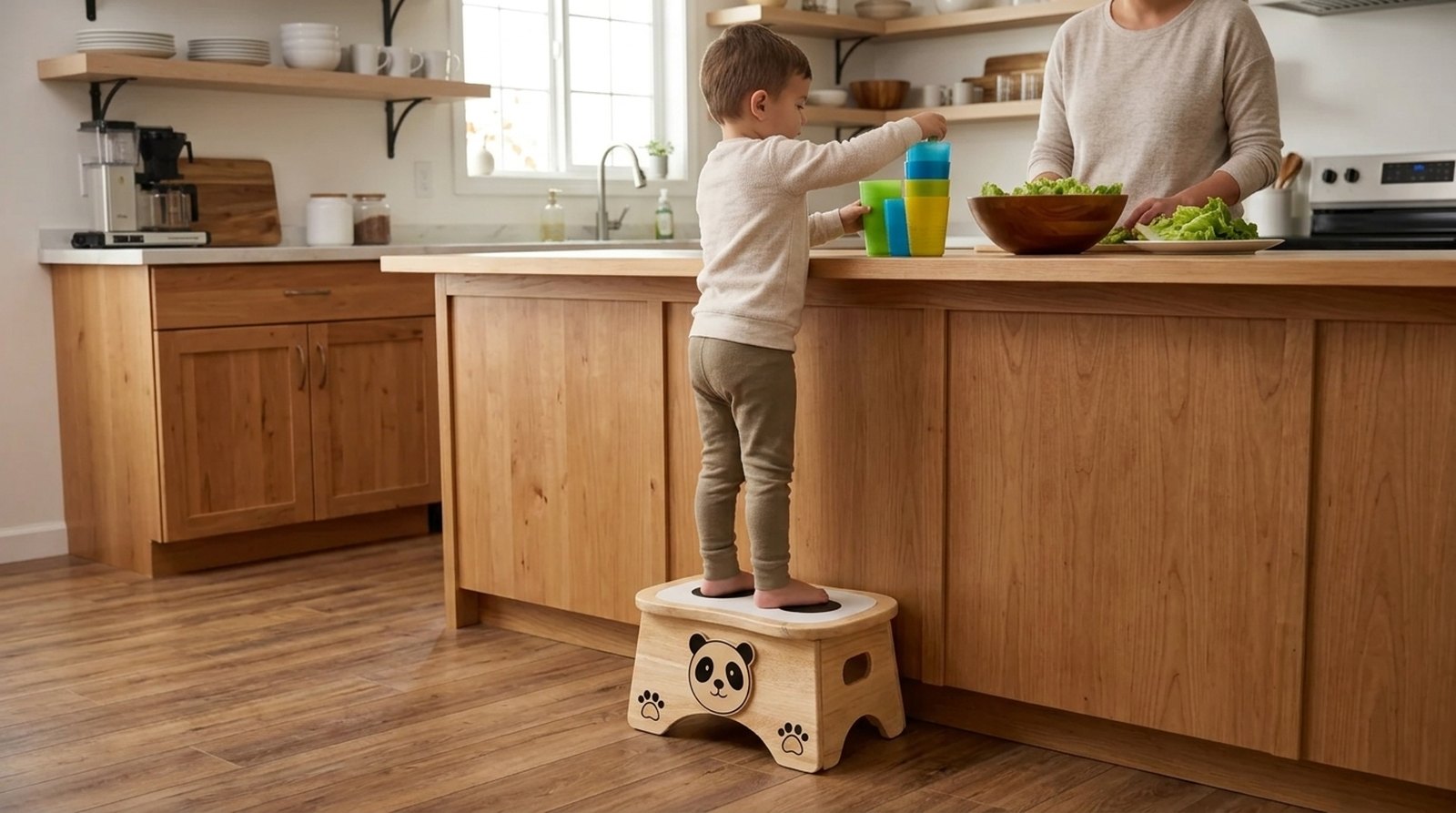
A kitchen step stool brings a child up to the counter and the sink, so they can stand next to you and do real kitchen jobs instead of watching from the floor. Rinsing fruit, stirring a bowl, tearing lettuce and setting out cups all become things they can do themselves, with you close by. Here is what they can do up there, where you should stay, and how to choose one.
Why does a child need a kitchen step stool?
The family kitchen is built for adult height. From the floor, a child sees the underside of the counter and the front of the cabinets, and nothing that is actually happening. Lift them onto your hip and you have one hand left to cook with. A child's kitchen step stool solves both problems at once: it brings them up to where the work is, and it leaves your hands free.
It also changes who does the job. A child who can see into the bowl wants to stir it. A child who can reach the tap wants to rinse the berries. Small jobs like these are how children learn they are part of the household.
What can a child do from a step stool at the counter?
More than most parents expect. The best first jobs are cool, safe and a little messy. Here are the ones that work well from a step stool at the counter and the sink.
- Rinse fruit and vegetables. Berries in a colander, apples, potatoes with a soft brush. At the sink, this is often the favorite job of the day.
- Tear lettuce and herbs. Small hands are good at tearing leaves into a salad bowl, and there is nothing sharp involved.
- Stir and mix. Pancake batter, muffin mix or yogurt and fruit, in a big bowl set back from the edge of the counter, well away from the stove.
- Measure and pour. Scoop flour, level it off, tip it in. Pour water or milk from a small pitcher into a cup.
- Mash. A ripe banana for pancakes, or avocado in a bowl, with a fork.
- Set out cups, plates and napkins. Their own cup can live within reach of the step stool so they can fetch it and fill it at the sink.
- Wash up and wipe down. Rinse their own plate, scrub a pot that has cooled, wipe crumbs off the counter with a damp cloth.
Start with one job, show it slowly once, then hand it over. Expect spills. The skill is in the doing, not in the result.
Where should the adult be?
Next to them. A step stool gives a child reach, and reach goes both ways: a child at counter height can also touch things that are not meant for them. A few habits keep the counter a good place to help.
- Keep the step stool away from the stove. Set it at the sink or a stretch of counter with no burners next to it, and cook on the back burners while your helper is up.
- Keep sharp tools out of reach. Knives, peelers, graters and scissors go to the back of the counter or into a drawer before your child steps up.
- Watch the hot tap. A child who can reach the tap can reach the hot side. The US Consumer Product Safety Commission recommends setting your water heater to 120°F to reduce the risk of scalds.
- Stay within arm's reach while they are up, and teach them to step down before they turn away.
Kitchen helper or step stool?
A kitchen helper, often called a toddler tower or learning tower, is a tall standing platform with rails on several sides. It stays at the counter and works well for a child who is still unsteady and likes to lean on the sides. It is also large, and most are too heavy for a child to move.
A kitchen step stool is smaller and simpler. It brings a child up to the counter, then goes with them to the sink, the bathroom and anywhere else they need to reach. It takes up little floor space, and a child can carry it and step up and down on their own, which is the point once they are steady on their feet. Some families use both. We compared the two in more detail in Toddler Tower or Step Stool.
What makes the best kitchen step stool?
- A wide base, so the stool stays put when a child leans over the counter to stir.
- A top that keeps small bare feet from slipping, because the floor in front of the sink gets wet.
- Light enough for your child to move, with a carry cutout, so they can bring it from the sink to the counter themselves.
- Easy to wipe clean. Flour and batter will land on it.
- Safety testing to ASTM F2613, the US safety standard for children's chairs and stools, alongside CPSIA compliance.
- A character they like. A step stool your child is fond of is one they go and get when they want to help.
Set up a spot that is theirs
Pick one stretch of counter beside the sink, away from the stove, and make it the helping spot. Keep their own apron on a hook they can reach from the step stool, their own small bowl and cup in one place, and a cloth for spills. When the step stool always comes back to the same spot, your child knows where to go when they hear you start cooking.
The same step stool can work in the bathroom, too. If you are setting up the sink and toilet as well, we covered that in Montessori Bathroom Setup.
Questions parents ask
Kitchen helper or step stool: which is better?
A kitchen helper suits a child who still wants rails around them and a fixed spot at the counter. A step stool suits a child who can step up and down confidently by themselves, takes less space, and moves with them from the kitchen to the bathroom.
When is a child ready to help from a kitchen step stool?
When they can step up and down confidently by themselves and are steady on their feet. Until then, stay close and lend a hand.
What is the best kitchen step stool for a child?
Look for a wide base, a top that keeps bare feet from slipping, a carry cutout so your child can move it, and testing to ASTM F2613. After that, pick the one your child will want to use.
What jobs should a child avoid at the counter?
Anything near the stove, the oven or a sharp tool. Rinsing, stirring cool bowls, tearing, pouring and setting the table are the best places to start.
Where Stobbi fits
Stobbi makes single-height step stools in solid natural wood, on a wide base with a carry cutout and a character on every one. Ray the Panda is happy at the kitchen counter, and like Doe the Turtle and Mei the Butterfly, Ray goes wherever your child needs to reach next. See all three in the shop.