
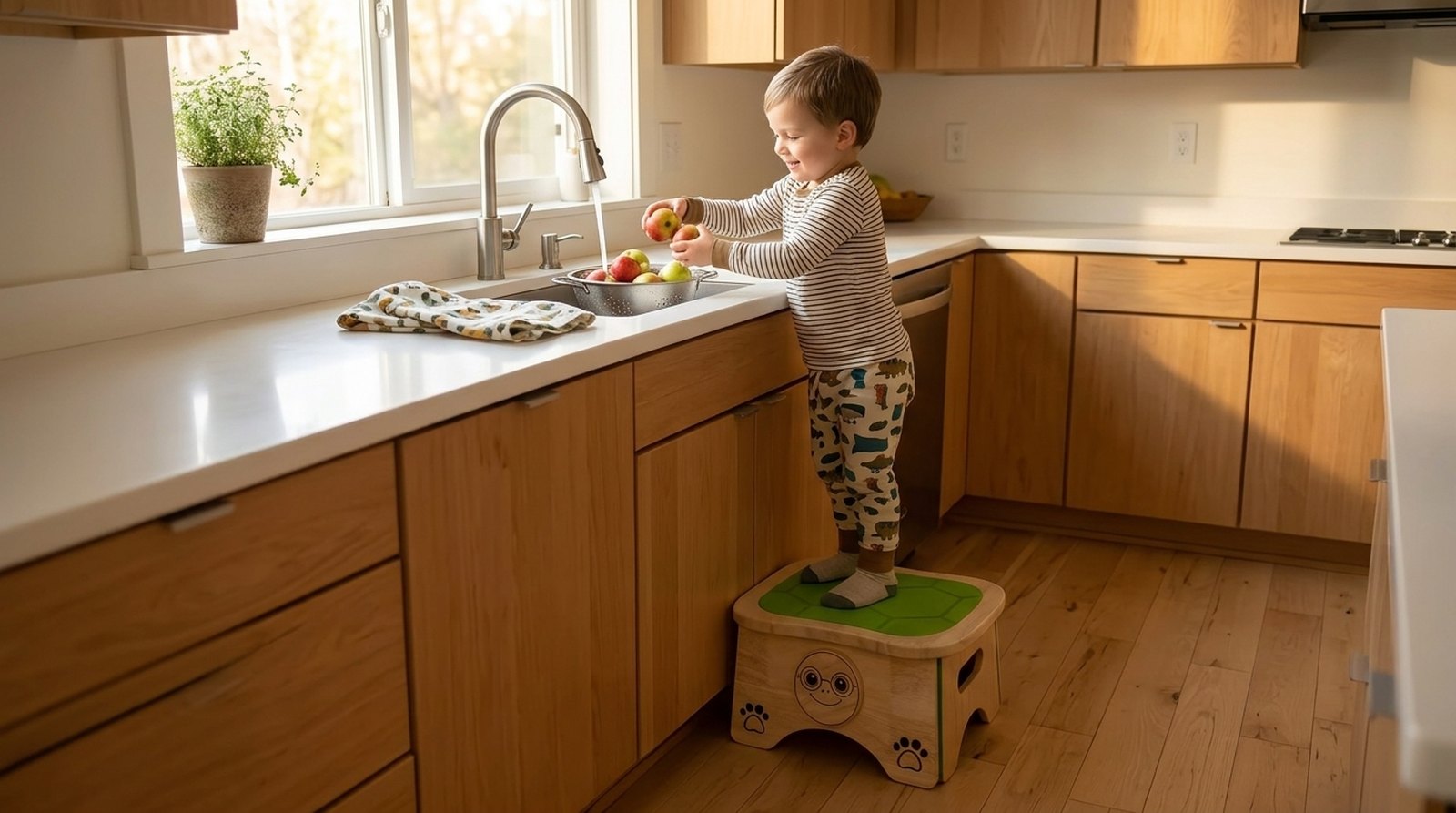
The best children's step stool is one your child can step up onto alone, that stays put when they lean in, and that they actually want to use. In practice that comes down to five things: a wide, steady base, a top that keeps small bare feet from slipping, enough height to bring them up to the sink, the counter or the toilet, a weight they can move without you, and recognized safety testing. If you prefer wood, look for solid natural wood. Here is how to judge each one, in a store or on a product page.
What is a children's step stool for?
A step stool has one job: bringing your child up to the real family space. The bathroom sink, the kitchen sink, the counter where dinner gets made, the toilet. Without one, every one of those routines needs an adult to lift, hold or fetch. With one, your child can use the toilet, wash their hands or rinse a cup on their own while you stay close. The right stool does that in every room, not just one, so it is worth choosing with the whole house in mind.
Potty learning is where a step stool earns its place fastest. It lets your child climb up to the toilet without being lifted, then step down and carry the stool to the sink to wash their hands. When the whole routine is theirs, it stops being something that waits for you.
How stable should a step stool be?
Stability matters more than anything else on this list. Children do not stand still on a step stool. They lean over the basin, reach for the tap, turn to talk to you and shift their weight from foot to foot. Look for:
- A wide base that rests flat and square, wider than the top if possible, so the stool stays put when your child leans forward.
- Some weight to it. A stool that is too light can slide on tile or a smooth wood floor. One with a bit of heft tends to stay where it was placed.
- No wobble. Press down on each corner in turn. A well-made stool does not rock or flex.
- Non-slip feet or a base that rests firmly on the floor, especially for bathrooms, where floors get wet.
What should the top feel like?
Many children step up barefoot, so look for a top that keeps small bare feet from slipping: a textured or matte surface rather than a glossy one. It should also be big enough for both feet to stand flat and side by side, with a little room to shift. Rounded edges and corners are kinder to shins and toes.
How tall should a children's step stool be?
Tall enough to close the gap between your child and the thing they need to reach, and no taller. A stool that lifts them so the edge of the sink or counter meets them around the waist is usually right: their hands can work comfortably above it, and they are not bent over a long drop. Bathroom vanities in many homes are a little lower than kitchen counters, so one single-level step stool often covers the sink and still helps at the counter. If the gap is very large, a taller setup may suit better, which we compare in Toddler Tower or Step Stool?
Can my child carry it?
A step stool that lives in one spot only solves one problem. The one that moves from the toilet to the bathroom sink to the kitchen solves all of them. Look for a carry cutout that small hands can hold, and a weight your child can manage without dragging. There is a balance here: heavy enough to stay put, light enough to carry. Solid wood stools with a carry cutout tend to land well in that middle ground.
What is the best wooden step stool for my child?
The best wooden step stool for a child is made of solid natural wood, stands on a wide base, has a top that keeps small bare feet from slipping, has rounded edges, has a carry cutout, and has been tested to the US safety standard for children's stools. Solid wood gives a stool real weight and steadiness underfoot, feels warm rather than slick, and looks like furniture, so you are happy to leave it out in the bathroom or kitchen. Check that a listing says solid wood if that matters to you. Some wooden stools use plywood or composite board instead, which can work well but feels and wears differently.
What safety testing should a step stool have?
In the US, look for a step stool tested to ASTM F2613, the safety standard for children's chairs and stools, and for CPSIA compliance, which covers things like lead and other substances in children's products. A brand should be able to tell you both without hesitation. Testing does not replace supervision. Stay close while your child learns to step up and down, and keep the stool clear of the stove and anything hot or sharp in the kitchen.
Will my child actually use it?
This is the part product pages rarely mention. A step stool only helps if your child walks over to it on their own. Children are drawn to things that feel like theirs: a color they love, a character they can name, a stool they chose. A stool your child likes is one they fetch themselves for the potty or handwashing, without being asked, which is the whole point.
A short checklist
- Wide, flat base that does not rock when pressed at each corner.
- A top that keeps small bare feet from slipping, big enough for both feet.
- The right height for the sink or counter you need most.
- A carry cutout and a weight your child can move.
- Rounded edges all round.
- ASTM F2613 testing and CPSIA compliance.
- Something your child is excited about.
Questions parents ask
What is the best wooden step stool for my child?
One in solid natural wood with a wide base, a top that keeps bare feet from slipping, rounded edges, a carry cutout and ASTM F2613 testing. After that, choose the one your child is most excited to use.
When is a child ready for a step stool?
When they can step up and down confidently by themselves and are steady on their feet. Until then, stay close and lend a hand.
Does a step stool help with potty training?
Yes. A step stool lets your child climb up to the toilet on their own, and the same stool brings them up to the sink to wash their hands afterward. Doing the whole routine without being lifted is a big part of potty learning.
Do I need more than one step stool?
Many families start with one and move it around. If two routines happen at the same time each day, such as potty trips upstairs and helping in the kitchen downstairs, a second saves the daily shuffle.
Is a heavier step stool better?
A little weight helps a stool stay put, but your child should still be able to carry it. Look for heft combined with a carry cutout rather than weight alone.
Where Stobbi fits
Stobbi makes single-level step stools in solid natural wood, each on a wide base with a top that keeps small bare feet from slipping, a carry cutout and a character on the front. Doe the Turtle is one of three, alongside Ray the Panda and Mei the Butterfly. They are designed for children who can step up and down confidently by themselves, and they go wherever your child needs to reach, from the toilet to the bathroom sink to the kitchen counter. You can see all three in the shop.