
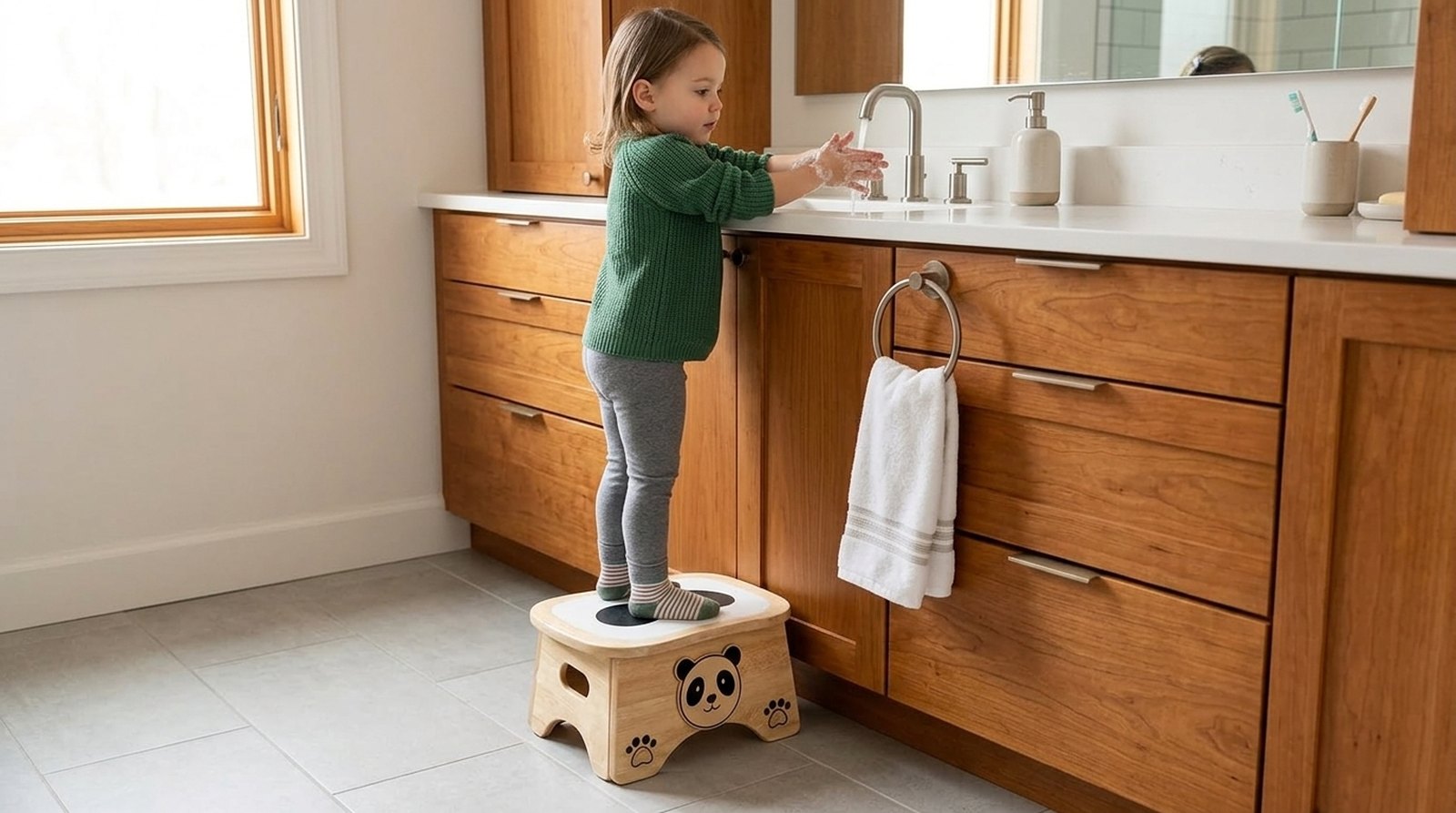
Both work. A plastic step stool is light, inexpensive and easy to wipe clean, which is why so many families start with one. A wooden step stool in solid natural wood is heavier and steadier underfoot, feels warmer to stand on, holds up to daily use and looks like furniture rather than equipment. Which one suits you depends on where it will live, who will move it and how long you want it to last. Here is a fair look at both.
What does a plastic step stool do well?
Plastic has real strengths, and it is worth being clear about them.
- Light. A small child can pick up a plastic step stool and carry it from room to room with no trouble at all.
- Inexpensive. Plastic stools usually cost less, so buying one for each bathroom is easy on the budget.
- Wipeable. Toothpaste, soap and splashes wipe straight off, and water does not bother it.
- Often foldable or stackable. Some designs fold flat or nest, which helps in a small apartment.
- Non-slip details. Many good plastic stools have rubber feet and a textured top, which helps on wet tile.
If you need something light for a child who is still learning to move things around, or a backup stool for a guest bathroom, plastic is a sensible choice.
What does a wooden step stool do well?
Solid natural wood brings a different set of strengths.
- Weight and steadiness. A solid wood step stool has more mass, so it tends to stay where you put it when a child leans forward over the sink or turns to talk to you. That extra weight is the main reason parents switch.
- Feel. Wood is warmer and quieter underfoot than plastic, and it does not flex or creak when a child shifts their weight.
- Lasts. A well-made solid wood stool takes daily use in its stride, and scuffs tend to read as character rather than damage. A good one can be passed on to a younger sibling.
- Looks like furniture. A wooden step stool can stay out in the bathroom or the kitchen all day without looking like something to tidy away. That matters, because a stool that stays out is a stool your child uses.
Is a heavier step stool harder for a child to move?
It can be, which is the honest trade-off with wood. The fix is design rather than material: look for a carry cutout that small hands can hold and a size your child can manage. A solid wood stool with a carry cutout gives you the steadiness of weight and still lets your child take it from the bathroom sink to the kitchen counter on their own. A very light stool is easy to carry, but on a smooth floor it may slide if it has no rubber feet, so check that detail on any plastic model.
Which is better in a wet bathroom?
Plastic shrugs off water, and that is a genuine advantage. Wood is perfectly at home in a bathroom too, as long as it has a finished, sealed surface and you wipe up standing water rather than leaving the stool in a puddle after bath time. Either way, the top matters more than the material underneath. Look for a top that keeps small bare feet from slipping, especially wet ones. We wrote about setting up the sink and the toilet in Montessori Bathroom Setup.
Which one lasts longer?
That depends on the quality more than the material. A thick, well-made plastic stool can last a long time. Thin plastic can crack or bow under heavy daily use, and some colors fade in strong sunlight. Solid wood is hard to wear out with ordinary use. It can dent or scuff, but it does not turn brittle with age, and a dented wooden stool is still a sturdy one.
What is the best non-plastic step stool?
If you want to avoid plastic, a step stool in solid natural wood is the most common choice. The best ones combine solid wood with a wide base, a top that keeps small bare feet from slipping, rounded edges, a carry cutout and testing to ASTM F2613, the US safety standard for children's chairs and stools, alongside CPSIA compliance. Read the listing carefully: "wooden" can mean solid wood, plywood or composite board, and some stools that look like wood are plastic with a wood-effect finish. Plywood and board can be perfectly good, but if solid wood is what you want, check that the listing says so.
A side-by-side summary
- Weight: plastic is lighter and easier to carry. Solid wood is heavier and tends to stay put.
- Price: plastic usually costs less. Solid wood usually costs more.
- Water: plastic ignores it. Sealed wood is fine with a wipe.
- Feel: plastic can flex a little. Solid wood feels firm and quiet.
- Lifespan: depends on quality for both. Solid wood tends to age well.
- Looks: plastic reads as gear. Wood reads as furniture.
Whichever you choose, the safety basics are the same. Supervise while your child learns to step up and down, keep the stool away from the stove and anything sharp, and set it square on a flat floor.
Questions parents ask
What is the best non-plastic step stool?
One in solid natural wood with a wide base, a top that keeps bare feet from slipping, rounded edges, a carry cutout and ASTM F2613 testing.
Are plastic step stools safe?
Many are. Look for a wide base, rubber feet, a textured top and safety testing, the same things you would look for in a wooden one.
Can a wooden step stool go in the bathroom?
Yes. Choose one with a sealed, finished surface, wipe up splashes, and do not leave it standing in water.
Is a wooden step stool too heavy for a child to carry?
Not if it is designed for them. A carry cutout and a sensible size let a child who can step up and down confidently by themselves move it on their own.
Where Stobbi fits
Stobbi makes step stools in solid natural wood, with a wide base, a top that keeps small bare feet from slipping, rounded edges and a carry cutout. Every Stobbi step stool is CPSIA and ASTM F2613-22 compliant. What sets Stobbi apart is that each step stool is a character. Doe, Ray and Mei each have a name and a face, so the step stool your child reaches for at the sink is a friend they know, one they help and who helps them back. Ray the Panda is one of three characters, alongside Doe the Turtle and Mei the Butterfly. Each one looks like furniture you are happy to leave out, and like a friend your child is happy to step up on.