
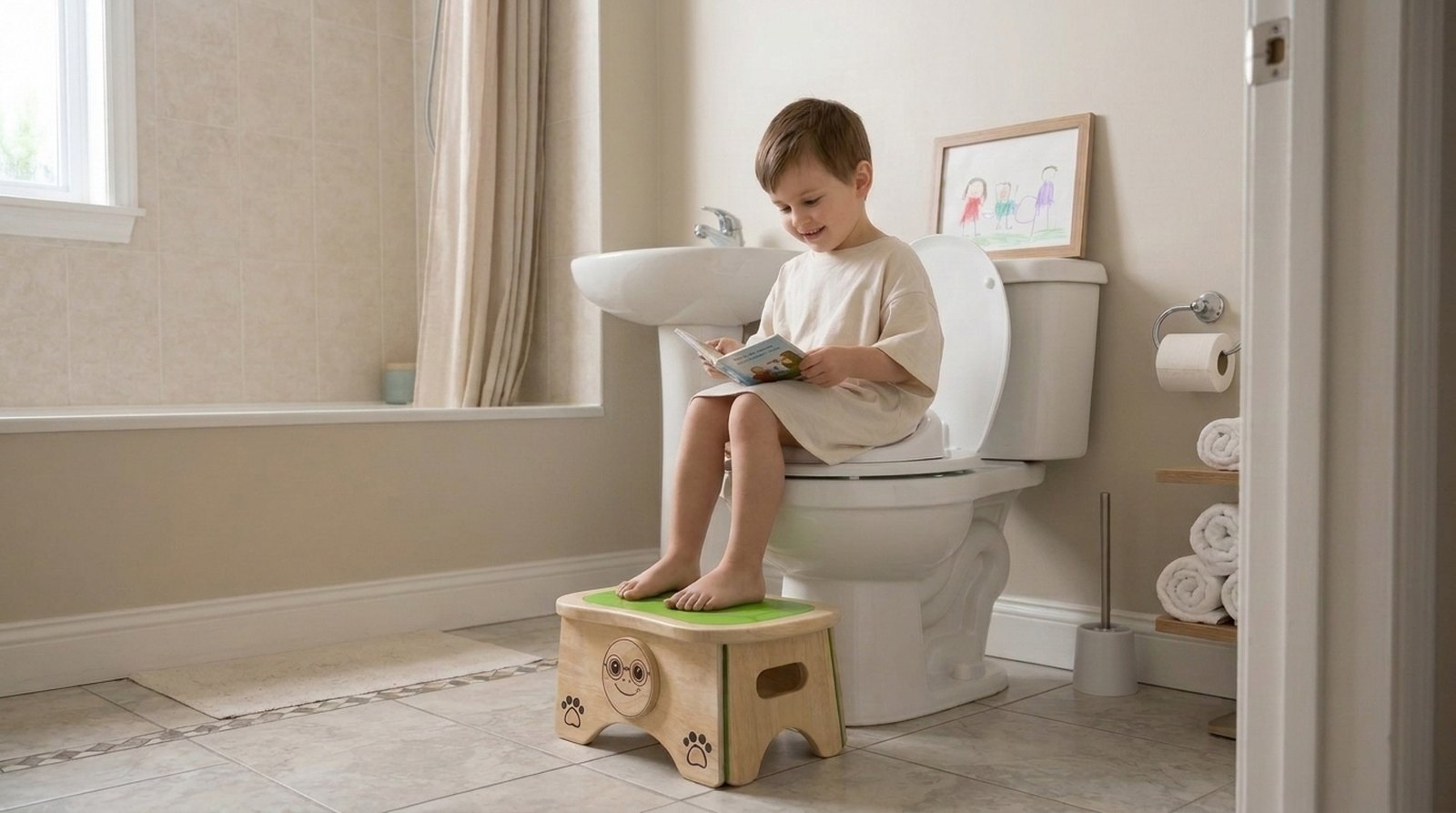
Yes, a step stool helps with potty training. A potty step stool lets a child climb onto the family toilet without being lifted, gives their feet something solid to rest on while they are there, and then carries them to the sink to wash their hands. Each of those turns a job you used to do for them into one they can do themselves, and owning the routine is most of what potty training is.
Does a step stool help with potty training?
It helps in three practical ways.
- Getting on and off. The family toilet is built for adults. Without a step stool, a child has to wait for you to lift them, and waiting is exactly what a child who needs to go cannot do for long.
- Footing while they are there. Feet that dangle make a child feel unsteady. Feet resting flat on a step stool help them feel balanced and relaxed, which makes it easier to go.
- Finishing the job. Once they step down, a child can flush on their own and head to the sink, where the step stool brings them up to wash. The whole routine is theirs from start to finish.
We covered the bathroom basics, sink and toilet together, in Montessori Bathroom Setup. This post goes deeper on the toilet itself.
Potty chair or the toilet with a step stool?
Plenty of families start with a small potty chair on the floor, and that works well for early practice. At some point, though, a child moves to the family toilet: at home, at a grandparent's house, at school. A step stool and a toilet seat insert sized for a small child make that move easier, because the child is already using the same toilet everyone else uses. Some families skip the potty chair entirely and start at the toilet. Either path is fine. What matters is that your child can get there on their own.
How a child gets on and off the toilet with a step stool
It helps to teach the movement in the same order every time, slowly, out loud, until your child can do it without you.
- Lid up. Lift the lid and put the toilet seat insert in place if you use one.
- Step up. Your child steps up onto the step stool, facing the toilet.
- Turn around. Standing on the step stool, they turn so their back is to the toilet, push their pants down and shuffle back onto the toilet seat.
- Feet down flat. Once they are on the toilet, their feet rest flat on the step stool, knees comfortable.
- Done. Wipe, feet back onto the step stool, stand up, pants up.
- Step down. Down onto the floor, one foot at a time.
- Flush. They press the handle and watch it go. For many children this is the best part. Then it is off to the sink.
Stay close for the first weeks. Turning around on a step stool takes practice, and a child in a hurry tends to rush it.
Where to put a toilet step stool
Set the step stool square in front of the toilet, close enough that your child's feet land on it naturally once they are on the toilet seat. Leave enough room for them to turn around. Keep the floor around it dry, and choose a step stool with a top that keeps small bare feet from slipping, because bathroom floors get wet. If the step stool also goes to the sink, show your child where it comes back to afterward.
From the toilet to the sink
Potty training is not finished until the hands are clean. The same step stool that got your child onto the toilet now brings them up to the sink. Teach the handwashing order out loud: step up, tap on, wet hands, soap, rub, rinse, tap off, dry, then step down. The CDC suggests scrubbing for at least 20 seconds, about as long as humming Happy Birthday twice. Keep your child's own towel on a hook or bar they can reach from the step stool, so drying happens before they step down, not after.
Small things that build independence
- Clothes they can manage. Pants with an elastic waist are far easier to push down and pull up than buttons and zips.
- The same words every time. A short, calm routine is easier to remember than a long one.
- Let them do each part. Even when it is slower. A child who climbs up, flushes and washes on their own is building the habit you want.
- Expect accidents. They are part of learning. Stay matter of fact, clean up together and try again next time.
- Follow your child's lead. Common signs a child is ready to start include telling you they need to go, staying dry for longer stretches and showing interest in the toilet. Your pediatrician is the right person to ask if you are unsure.
What to look for in a step stool for toilet training
- A wide base, so it stays put while your child turns around on it.
- A top that keeps small bare feet from slipping, wet or dry.
- Light enough for your child to move, with a carry cutout, if one step stool will serve the toilet and the sink.
- Easy to wipe clean, for obvious reasons.
- Safety testing to ASTM F2613, the US safety standard for children's chairs and stools, alongside CPSIA compliance.
- A character your child likes. A friend waiting at the toilet is a small reason to go and try.
Questions parents ask
Does a step stool help with potty training?
Yes. It lets a child get onto the toilet without being lifted, keeps their feet supported so they feel steady, and lets them flush and wash on their own afterward.
What is the best step stool for potty training?
One with a wide base, a top that keeps bare feet from slipping, a carry cutout so your child can move it to the sink, and testing to ASTM F2613. After that, pick the one your child is happy to step up on.
Should the toilet step stool stay at the toilet?
It can. Many families keep one step stool at the toilet and another at the sink, so neither routine depends on moving it. One works too, if your child can carry it.
When is a child ready to use a step stool at the toilet?
When they can step up and down confidently by themselves and are steady on their feet. Until then, stay close and lend a hand.
Where Stobbi fits
Stobbi makes step stools in solid natural wood, on a wide base with a carry cutout and a top that keeps small bare feet from slipping. Doe the Turtle is a steady friend at the toilet, and like Ray the Panda and Mei the Butterfly, Doe goes with your child to the sink and anywhere else they need to reach. See all three in the shop.